Weather: Grey, but it is not raining. Just back from a dog walk along the South Downs, with views that stretch miles upon miles. It’s as if you are in heaven up there on a clear day. Then for a flapjack (bit like an Anzac biscuit) and coffee at the National Trust mansion, Uppark, also perched at the top of the Downs. I had the café all to myself with views as far as the South Coast.
I have just read an article by Peter York (The Independent-23rd April, 2011) who defined Sloanedom in his hit 1982 book The Official Sloane Ranger Handbook – people took it very seriously – the Bible for poshness. It was about Kate and William’s wedding almost 5 years ago and how society had changed since Di and Charles’ wedding in 1981. He posed the idea that Sloane rule had been usurped by a global super wealthy “over-class”. He made the point that even the aristocratic top tier – with hereditary titles lurking around, like Duke, Earl, Viscount and Marquis (see Burke’s Peerage) – had been largely overtaken in terms of wealth by newcomers. The Rich List, since it was first published in the late 80s, apparently reflects this social change. Does money now rule?
One aristocratic friend who I shall refer to in future blogs as The Hon. (meaning her father was titled), explained to me that in her father’s day, Oxford and Cambridge were dominated by the male aristocracy (inherited titles) and upper middle class (gentry, including some life titles that would evaporate with death), forming the Sloane world. They shared a Public School education (i.e. private in Britain) and were the captains of industry. This is much less true today; for example, the City (the equivalent of Wall Street), or the world of “Tech”, have people from all walks of life reaching the top. That’s true of most sectors actually. And they are the ones now snapping up the big houses in the Royal Borough of Kensington and Chelsea. And they are often foreign. And they are of both sexes.
After the deregulation of the stock exchange in 1986 and the switch to electronic trading, known as the Big Bang, foreign banks, principally American, gobbled up a big chunk of the City. The Old Boys’ Network, run by Sloanes, was engulfed. The increase in the cost of oil in the 1970s and 80s made the Middle East rich. China’s economy has been growing to the size of a ‘dragon’ for decades. London has become a haven for the world’s super-rich.
Yesterday’s Book Club was on usual fine form and its profile reflects these social changes. Seven pheasants, including another Hon., two Americans, a Zimbabwean and me. The pheasants who are my age, or thereabouts, would have dressed like Diana in the 1980s and 1990s. With the emergence of the super-rich, their dress sense has morphed too. I was amused to see that four of the Book Club wore fur gilets (loose waistcoats). There wasn’t a Barbour (waxed outdoor coat), husky (vinyl quilted jacket), striped/checked shirt, pearls, pleated woollen skirt, flat sensible leather shoes (with a gold chain) or a velvet Alice band (the Sloane uniform – think the Queen on non-State occasions) amongst them.
Tailored jeans and the odd label (the effect of globalisation) were the priority. I admired the Zimbabwean’s trousers – Dolce and Gabbana. And some serious bling was on display. Sloanes in the 80s90s wore small, understated jewellery: gold studs, a gold chain with cross and a sensible watch. It is now okay to wear diamonds, other than your engagement ring, in daylight.
One thing that hasn’t changed is schooling for Sloanes and internationals. In the case of this Book Club, it is mainly boarding schools for boys: Radley, Harrow, Wellington, Stowe and Ampleforth.
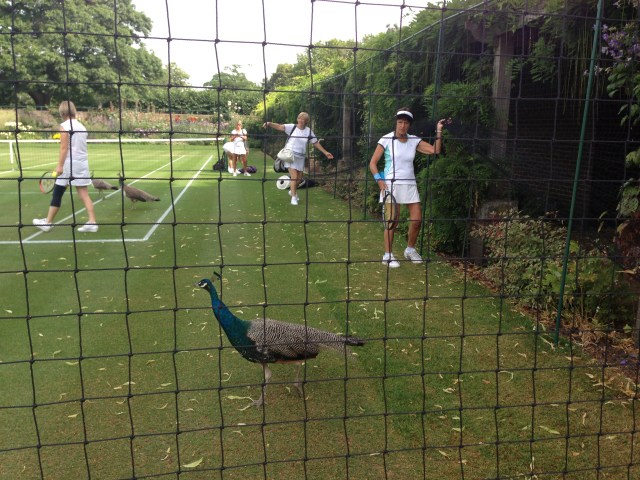
Pheasants chasing a peacock off the tennis court
Conversation: children’s progress at school, birthday parties (was it appropriate to give a rabbit along with membership to a smart (not clever, but posh) nightclub for an 18th birthday present, cookery courses, skiing (hostess had injured her arm at Klosters, the resort favoured by the Royals), charity events to attend, a series on Israeli/Palestinian relations to attend in Covent Garden, art exhibitions, films, possibility of a holiday abroad together and, yes, a little bit about the book. You see, Book Club is not really about the book. It is about friendship.
The rest of today is a ground hog day.
 Diary of a Sloane Sheila