Day 14

Yesterday evening had a happy meal with fellow Aussies at the pub, the Scarsdale, in Kensington. Pubs in England, especially in country villages, are very different from the suburban pubs I knew growing up in Sydney. The English variety are charming, welcoming, cosy – low back leather Chesterfield sofas in front of a glowing log fire, with a friendly publican chatting animatedly to customers while he or she pulls pints of foamy ale (warmer than lager, which the Aussies prefer).  Last weekend, we went to the Thomas Lord pub in West Meon, named after the founder of Lords’ cricket ground.  Above the bar there was a glass cabinet showcasing a cricket match in an English village scene, but played by stuffed squirrels and weasels.  Could only happen in England. And dogs are welcome. A posh old gent in an old sailing shirt was drinking a pint while feeding his lurcher treats and chatting to him as if he was a child.

The ‘Watering Holes’ in Sydney as they were called were male only (women in a separate lounge), where white blue-collar workers imbibed large amounts of lager before heading home after work. The pubs were utilitarian places, with lino bar counter tops and tiled walls – easier to clean the sweat, dirt and spillages and the occasional chunder (vomit).
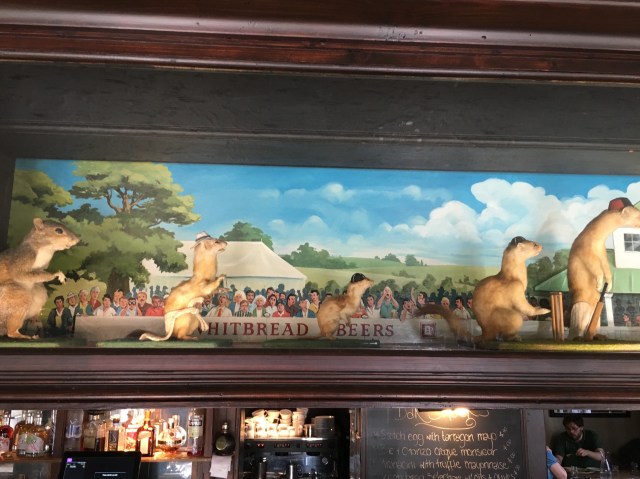
squirrel.jpg

Stuffed animals posing as cricketers at Thomas Lord pub

In 1916, a law was passed that pubs had to close at 6pm, so if the Aussie worker wanted to consume his full quota of beer, he had to down it in an hour, with obvious results! The “six o’clock swill” was finally abolished in 1955, but the male only beer culture had by then been firmly established in Australia with almost religious fervour. It was an Aussie bloke’s territory, ie non Europeans, aborigines and women were not welcome. With the advent of the women’s movement in the 70s, this attitude became more relaxed. In 1982, massive random breath testing was introduced and the male only pub culture was clobbered.

Male only drinking establishments in England are at other end of the social spectrum. These are exclusive gentleman members’ clubs, many founded in the mid 19th century by the upper classes in central London. Many now allow woman guests, but White’s in St James, Piccadilly, still prohibits their entry. To date the Queen has been the only female guest.

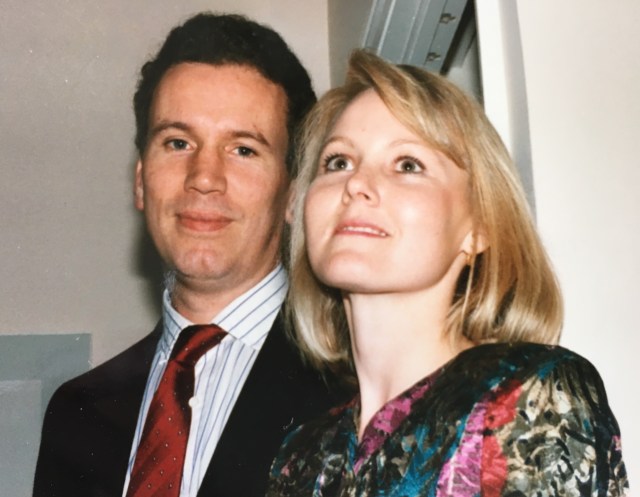
Soon after my date with Geoffrey at the Savoy, etc, he invited me to a weekend away on the Norfolk coast with some friends, ostensibly to show me the seaside. The North Atlantic sea was so different. Slate grey and forbidding. And instead of golden sand there were pebbles. Over the weekend we went to pubs after sodden walks in the countryside. Young unmarried Sloanes often hung out in pubs after desperately cold, wet walks. On the way home we went to Cambridge where Geoff’s grandfather and great grandfather studied at Trinity College. We went to the Free Press pub for lunch. Pubs in those days sold solid, traditional British food: roast beef, cottage pie and fish and chips. That sort of thing. Now this fare has given way to the gastro pub, with fancy stuff on the menu. Romance blossomed despite the wet weather that weekend. Against the odds, we found that this kangaroo and this stag actually had a lot in common.

By the 10th September, 1988, Susan and David’s wedding at the Hurlingham, Geoff and I were an item, with no fixed port of destination obvious.
 

Day 13

Yesterday was ground hog day. Lots of admin. Yawn. Boring.

Today the weather is mixed. Tonight, I am playing tennis in the new Racket Centre with Geoff, followed by a quick dinner in the cafeteria, called the Harness Room, as the first international polo match between England and the United States was played at the Hurlingham. Sloanes revere horses and all pursuits involving them. They also revere dogs. All other animals they can take or leave. 

Yesterday, I described how younger Sloanes have integrated global fashion into their attire; you will now see Cartier love bracelets on wrists, Louboutins on feet, Hermes Birkins over arms and Tom Ford sunglasses perched on ears. Are they usually worn by London dwelling Sloanes?  My guess is yes.  Sloanes may still don a string of pearls, but they may be Chanel.

In the 1980s, Sloanes did not, on the whole, wear foreign brands apart from Gucci loafers. Look at Diana. (She was born the year before me.) After her marriage in 1981, her style was ruffled collars with a ribbon adorning her the neck (Elizabeth I inspired), feathered and netted hats, puffed sleeves for long and short shirts, and gathered skirts with gold belts.

When Andrew Morton published “Diana: Her True Story” in May 1992, we all, sadly, learnt that the fairy tale marriage was over. Diana’s wardrobe changed tack overnight. Her evening dresses became figure hugging and cocktail dresses were even slinkier, shorter. More of the décolletage was shown. She was best friends with Versace, a designer and a foreigner.

Older Sloanes don’t really like foreigners. Think of the war! She sat beside Elton John at the designer’s funeral. Elton is a pop star. World class photographers like Patrick Demarchelier and Mario Testino photographed her for VOGUE, a glossy mag, with her hair gelled back and looking like a supermodel. Not very HRH.

By the time of Diana’s sad death in August 1997, she was very different from the young girl marrying Charles in St Paul’s cathedral, physically and in all other senses. She was, however, always a wonderful mother. I think that the Sloane evolved, largely because Diana evolved, and she was a fashion icon for them. 

Although Sloane pheasants have on the whole morphed along with fashion trends, there are some stalwarts, that have, refreshingly, stayed frozen in the 1980s/90s mould. And I love them for it. Look at the Queen. Never changing. The hair, always, as if someone has forgotten to remove the rollers from her bangs. And the black handbag and sensible shoes. 

So when I met Geoffrey in August 1988, I was crafted on the pre-divorce Diana, the uber- Sloane. He eventually rang me and asked if he could show me the sights of London. By then, I had landed a job as a solicitor in the City (big C for the business sector around Bank Underground), and I had splashed some cash on clothes for my new job. He suggested we meet at the Savoy on The Strand, near Covent Garden (featured the climactic scene in the Hugh Grant movie “Notting Hill”). I arrived first. This was a grand establishment. I was bouncing around nervously inside like a kangaroo, although I tried not to fidget. 

chin.jpg

Many moons ago.

The last time I’d seen Geoffrey he was in shorts, but this time he was in a tailored suit, tie and polished black brogues. He glided through the revolving doors, and smiled as he spied me sitting on one of the stuffed leather sofas. I thought, “Strewth, I am out of my comfort zone.” He said, “You look smart,” which means clever in Oz and nice in Britain. I thought he was commenting that I looked ready for work.

So we headed for the American Bar where someone was playing the grand piano, and once seated, he asked me what I’d like to drink. I had sometimes had gin and tonics with Susan’s parents, so I ordered one of those. As I lifted the glass to my lips, my hand was shaking so much that I thought that I was going to spill it down my ‘smart’ clothes.

Next we went to see a West End show, in theatreland, “Me and my Girl”, and after to Smollensky’s Balloon for steak and chips. By the end of the meal Geoff, smiling, said, “I feel like I’ve known you forever.” Oh dear, panic. Impossible to fall for a Brit. Well it is possible and I did. I’ve lived more than half my life in Britain and it has been a good life.

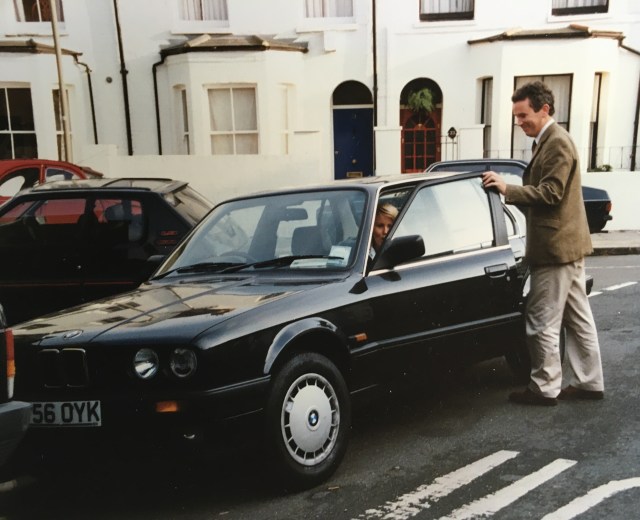
car.jpg

Picking me up from Frere Street, Battersea

Tonight I’m catching up with Gill from Australia with her husband Gary and we are going to a pub in Edwardes Square, Kensington, and tomorrow I’ll tell you about falling for Geoffrey Wilmot Esq.

Day 12

Weather: Grey, but it is not raining. Just back from a dog walk along the South Downs, with views that stretch miles upon miles. It’s as if you are in heaven up there on a clear day. Then for a flapjack (bit like an Anzac biscuit) and coffee at the National Trust mansion, Uppark, also perched at the top of the Downs. I had the café all to myself with views as far as the South Coast.

I have just read an article by Peter York (The Independent-23rd April, 2011) who defined Sloanedom in his hit 1982 book The Official Sloane Ranger Handbook – people took it very seriously – the Bible for poshness. It was about Kate and William’s wedding almost 5 years ago and how society had changed since Di and Charles’ wedding in 1981. He posed the idea that Sloane rule had been usurped by a global super wealthy “over-class”. He made the point that even the aristocratic top tier – with hereditary titles lurking around, like Duke, Earl, Viscount and Marquis (see Burke’s Peerage) – had been largely overtaken in terms of wealth by newcomers. The Rich List, since it was first published in the late 80s, apparently reflects this social change. Does money now rule?

One aristocratic friend who I shall refer to in future blogs as The Hon. (meaning her father was titled), explained to me that in her father’s day, Oxford and Cambridge were dominated by the male aristocracy (inherited titles) and upper middle class (gentry, including some life titles that would evaporate with death), forming the Sloane world. They shared a Public School education (i.e. private in Britain) and were the captains of industry. This is much less true today; for example, the City (the equivalent of Wall Street), or the world of “Tech”, have people from all walks of life reaching the top. That’s true of most sectors actually.  And they are the ones now snapping up the big houses in the Royal Borough of Kensington and Chelsea. And they are often foreign. And they are of both sexes. 

After the deregulation of the stock exchange in 1986 and the switch to electronic trading, known as the Big Bang, foreign banks, principally American, gobbled up a big chunk of the City. The Old Boys’ Network, run by Sloanes, was engulfed. The increase in the cost of oil in the 1970s and 80s made the Middle East rich. China’s economy has been growing to the size of a ‘dragon’ for decades. London has become a haven for the world’s super-rich.

Yesterday’s Book Club was on usual fine form and its profile reflects these social changes. Seven pheasants, including another Hon., two Americans, a Zimbabwean and me. The pheasants who are my age, or thereabouts, would have dressed like Diana in the 1980s and 1990s. With the emergence of the super-rich, their dress sense has morphed too. I was amused to see that four of the Book Club wore fur gilets (loose waistcoats). There wasn’t a Barbour (waxed outdoor coat), husky (vinyl quilted jacket), striped/checked shirt, pearls, pleated woollen skirt, flat sensible leather shoes (with a gold chain) or a velvet Alice band (the Sloane uniform – think the Queen on non-State occasions) amongst them.

Tailored jeans and the odd label (the effect of globalisation) were the priority. I admired the Zimbabwean’s trousers – Dolce and Gabbana. And some serious bling was on display. Sloanes in the 80s90s wore small, understated jewellery: gold studs, a gold chain with cross and a sensible watch. It is now okay to wear diamonds, other than your engagement ring, in daylight.

One thing that hasn’t changed is schooling for Sloanes and internationals. In the case of this Book Club, it is mainly boarding schools for boys: Radley, Harrow, Wellington, Stowe and Ampleforth. 

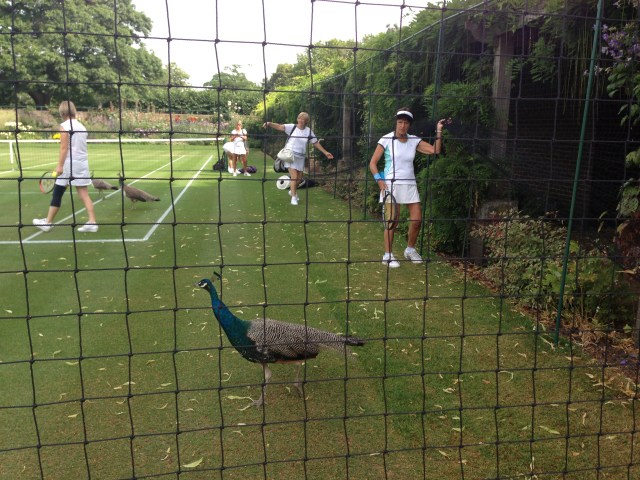
Hurl.jpg

Pheasants chasing a peacock off the tennis court

Conversation: children’s progress at school, birthday parties (was it appropriate to give a rabbit along with membership to a smart (not clever, but posh) nightclub for an 18th birthday present, cookery courses, skiing (hostess had injured her arm at Klosters, the resort favoured by the Royals), charity events to attend, a series on Israeli/Palestinian relations to attend in Covent Garden, art exhibitions, films, possibility of a holiday abroad together and, yes, a little bit about the book. You see, Book Club is not really about the book. It is about friendship.

The rest of today is a ground hog day.


Day 11

Mother’s Day was spent going through all the old photos stored in the basement and photographing them for the diary; stirring up a lot of memories.

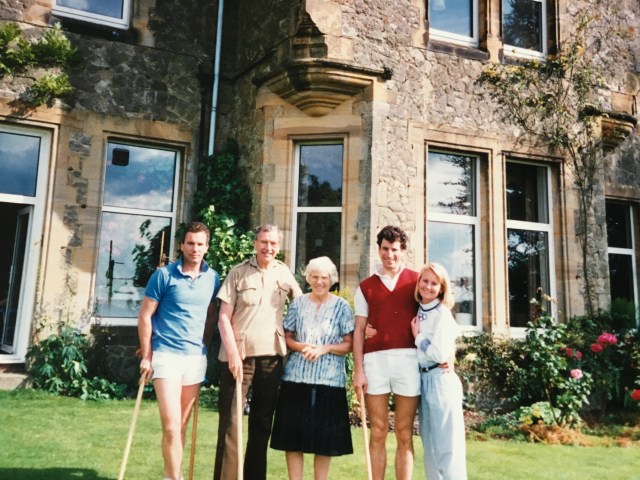
On Friday, I mentioned that Susan took me to meet her in-laws, the Wilmots, at Stone House, Kent, on my second day in England in August 1988 on an idyllic summer’s day. And how this was the first time I met Geoffrey, my future husband. Little did I know that Susan’s in-laws would become mine in six months’ time.

The first thing that I noticed was how quintessentially English their way of life was. Croquet on the lawn, scones and cakes at 4pm, on the dot. And their voices – just like the Queen’s. Tony Wilmot (father) was wearing a safari shirt. He and his wife, Eve, had lived in Africa all their married life until retirement. In fact, Eve’s father was a missionary doctor in Uganda and Ruanda, so once she married Tony, he essentially took her home. Tony first met Eve in a boarding house in Wimbledon just after WW2, and it was love at first sight for him. (He had been mentioned in dispatches for his war service in Africa, where he was rapidly promoted to colonel-in-charge of ciphers in East Africa.) They were formal, but warm and friendly.

I was obsessed in 1981 with the television adaptation of Evelyn Waugh’s Brideshead Revisited, starring  Anthony Andrews and Jeremy Irons (I once saw the latter on a return trip to Madrid and he was so dashing), which was partly set in Oxford. Tony was educated at Oxford, where he was taught by C.S. Lewis.

Stone House had that same air as Oxford after the Second World War: Empire, Queen, country, manners, formality and cerebral pursuits. I noticed a study full of books, African artefacts, the tick-tock of a grandfather clock somewhere in the distance. I later discovered that Tony and Eve always filled in the Daily Telegraph crossword after lunch and that the family regularly played Scrabble after dinner. Before bed, there were prayers.  This family was into words. They had memorised most of the Oxford Dictionary. 

bookends

We are bookends of each other

And now let’s talk about Geoffrey – Geoff. The first thing I noticed was that although he was trim and fit, he had relatively white legs compared to an Aussie male. He was polite, but aloof. He had that British reserve. I was not in the least bit attracted to him. He was too different from the sort of bloke I had rubbed shoulders with in Oz, in both looks and manner.

Susan and I gave him a lift back with us to London as he was going to see a Jacobean play (the period after Elizabeth I – 1567 to 1625) with a female friend – not a date. Can you imagine an Aussie bloke ever attending such an evening! He was bemoaning the fact that it was going to be boring. I suggested that if the evening became really dull, he could spice it up and give her a “cuddle”. I didn’t know that their relationship was platonic. He burst out laughing. He later told me that when I made him laugh, that was the first time he really clocked me.

Susan suggested he might like to show me the sights of London as part of his best man’s duties. We agreed to meet up sometime, with no fixed time planned.

So later is Book Club.

Day 10

I am back at the Old Rectory this morning, after dashing for a quick walk with Domino at the Hurlingham Club in London earlier. It was snowing, on the way down, as I hit the Hindhead Tunnel. The first flurries of snow this winter.

I love the Old Rectory. It is solid and substantial, unlike terraces in Chelsea, which are tall and thin and usually one room wide. I used to struggle with the idea that there were couples asleep in the adjacent rooms on either side of our bedroom when we lived in Limerston Street, Chelsea. I could have yelled out goodnight like in the Waltons. But the Old Rectory is also reminiscent of the old vicarage in Kent, Stone House, where, Geoffrey Wilmot, my husband grew up. His parents, Anthony and Eve, filled it with their family, all seven of them. Twins at the top and twins at the bottom – bookends.

I have misled you. I met my first pheasant, Susan, in Sydney. We were waiting to go into a university lecture on linguistics and she started chatting to me. I had never met a pheasant before, and she stuck out like sore thumb in the land of kangas and emus. First it was her attire. Sloaney. She was wearing a blue gathered skirt with a crisp white shirt. The shirt had puffed sleeves and a Peter Pan collar. She had ballet pumps. I later noticed that she wore a gold signet ring on the pinkie of her left hand, engraved with her family crest. And then there was her voice. Dead posh. I was wearing a canary yellow shirt and white dungarees and old tennis shoes. I looked like a cockatoo. Lady Di had not come onto the scene, so Susan was a novelty. A exotic creature that was fascinating and glamorous. Her nails were always manicured. Mine, I bit off. I had freckles and a tan. She had the flawless complexion of an English rose.

mummy

Susan and me in Palm Beach, Florida

Susan’s stepfather, Louis, Argentine (born in Argentina to British/American parents) and Susan’s mother, Joanna, (British; a WW2 refugee, brought up in Palm Beach, Florida), welcomed me into their family, and I spent hours at their house, sleeping over, talking politics, occasional gin and tonic (new to me).

They took me to my first smart restaurant in Sydney for Susan’s 19th birthday. The crowd was mainly posh Brits on gap years. I sat next to Louis and read the starter menu. I ordered the seafood salad thinking it would be a prawn cocktail. Out came a plate filled with mussels and oysters. Of course I knew what they were, because Dad loved them and gobbled them up in vast quantities, but my youthful palate was not so keen. Anyway, with my crisp white linen napkin glued to my lap and surrounded by ‘Hooray Henrys and Carolines’, I ventured the first bite of a mussel. I started to gag and without hesitation Louis turned to me, lifted my napkin to my lips and instructed, “Spit it out.” He then disposed of the napkin and asked the waiter to take away my plate. Supreme gentleman. We then all danced the night away at the upmarket disco there.

My life up until the age of 18 existed within a radius of ten miles, apart from the occasional visits to my grandparents’ holiday home on the North coast, The Weekender. Susan and her family helped me see beyond the horizon of Sydney Harbour to a big wide world that I had only glimpsed at through literature and cinema. They made it real and tantalising.

Susan asked me to be a bridesmaid at her wedding to her fiancé, David, at Holy Trinity Brompton, Knightsbridge, in September 1988 and afterwards at the Hurlingham Club. She had returned to London after Uni, completing her course two years earlier than me. I had made a possum’s mess of my life in Oz so I thought, “Why not try your luck Pottsie and go to England to the wedding and see if you can work over there in a London law firm.”

So on that second day in England, 2oth August, 1988, Susan and I headed down the A3 to Kent on a sunny day, with lamb’s wool clouds overhead, for me to meet her future in-laws and the best man, David’s brother. As we drove up the sweeping gravel to a large Victorian pile, I could see a group playing croquet on the lawn.

Now I stuck out like a sore thumb. I was the kanga in the land of pheasants and stags. Have you guessed by now? David’s brother was Geoffrey, the best man.  I was at Stone House and about to meet my future husband.

It’s mothers’ day this weekend. And on Monday it is Book Club in London. But not after some country tonic.


Day 9

The sun has got its hat on. Hip, hip, hip, hooray! My mother Bev taught me that song. I’ve just come back from a dog walk at Hurlingham with Vicky, a fellow member. Richard Branson’s mother was leaving after a spot of croquet. She the spitting image of her son.

Last night, I had dinner with friends that we met in 1993, when I was still kangarooing around the place: Paul Cowley MBE and his wife, Amanda, and Tricia Neill. We all did something called the Alpha course together over twenty years ago at HTB, an Anglican church in Knightsbridge. Tricia is now President of Alpha, and Paul pioneered work with ex-offenders, meeting them at the prison gate and helping them to reintegrate into society.  Paul himself has gone from prison to pulpit. In between, he was in the army (he did three tours of N. Ireland and one in the Falklands). When we met Tricia she worked for News International, organising exhibitions. Both of them have had a major impact on many people.  Dinner was at Tricia’s flat on Kings Road, in a new complex. 

I remember attending a wedding reception there in the late eighties, when it was a university campus. No doubt I was kitted out, yet again, in one of my many broad shouldered, over the top creations.

After Geoff and I married, we hit the wedding circuit big time. The pheasant-brides were still championing the Princess Di look. Large brimmed hats were obligatory. Stags wore, without exception, morning suits. If it was an officer’s wedding, there was usually a guard of honour. It was not the form, however, for the stag-officer to wear his uniform. He wore a morning suit like the other stags.

A sit down lunch or dinner, followed by dancing, was unheard of back in the 80s. Canapés (nibbles to Aussies) were served with champagne and tea, and after speeches, the happy couple departed, on their honeymoon, in a car defaced with lashings of shaving cream, balloons tied to the back bumper and rocks ricocheting in the hub caps. Things have changed over the years, but this was the way it was back then.

My father, Stan the Man, would have had a fit at the lack of tucker (food). Australian weddings were long drawn out affairs. The 80s/90s Aussie brides were crazy about the Diana meringue dress, but apart from that, an Aussie wedding was a very different kettle of fish. For starters, the bridal party consisted of a trillion bridesmaids and ushers, flanking the happy couple in rows facing the congregation. The ushers wore tuxedos. Sheila guests wore pretty frocks and no hats. Blokes wore lounge suits, if that. The dinner was a sit down saga, and the speeches went on and on like the Outback desert.

After saying goodbye to Anne, my best friend at Kingsgrove High School was Karen Nosworthy; Nos for short. She fell in love, as soon as she graduated, with Dallas Brown, a carpenter. I was the bridesmaid at their wedding in the early 80s, and my outfit was, in fact, chic. Nos always had style. Now she is an accomplished artist. The dress was made of delicate voile (with hand smocking that would have made any pheasant squeal with delight) and a pill box hat, with delicate netting over my face. The reception was at the Municipal Town Hall where I used to study in the library. Swot student by day, bridesmaid by night. 

Karen.jpg

Karen Nosworthy on the far right. Me in red. A typical Aussie ‘just tuck in’ lunch.

My combined Arts and Law degree was a long drawn out affair between 1981 and 1985, and I was dreaming of a life beyond the books. Day after day, I would find my usual cubicle, amongst the reference books, at the Town Hall. But before my study kicked off, there was one book I carefully examined, page by page, before I put my nose down to learn about contracts and torts. It was a table sized book of Charles’ and Diana’s wedding. I was enchanted by their fairy tale.  Then I would, reluctantly, put it back, and it would be back to reality.

Tomorrow, I’ll head off first thing back to the Old Rectory.

Day 8

Yesterday, I headed down to the Hampshire south coast to the charming seaside town of Bosham for a solitary walk along the harbour. There was a smattering of people pottering around the flat, calm, grey water – a world away from the pounding, effervescent surf of the East coast of Australia. Regal swans glided along the foreshore, hissing menacingly at Domino. I could hear the tinkling of rigging, flapping against masts of sailboats. I like the music it makes. It’s as if the boats are beckoning the sailors to release them and take them on an adventure. Just when I thought that the sun had left the solar system, the clouds parted and weak spring sunshine flooded the scene.

Dinner, the night before, with our friends on the Thames, was in the same vein. The strong tide whooshed past the picture windows, and white commuter ferries glided past, occasionally, like the swans I’d seen earlier in Bosham Harbour. 

I am now back in Fulham, London, at the ex-butcher’s Shop. It is hard to believe that dead meat was once sold here, as it is the prettiest little house you can imagine. It is unusually double fronted, but only one shallow room deep. I’ve white-washed the walls and accented the cool palette with the colours of the tropics: weed green, orange peach, flame coral, flamingo pink, sunny gold, cool aqua and turquoise.

The art is the same: a Slim Aarons print of an elegant  woman in white shorts (the socialite CZ Guest) standing by a classical topaz pool with her young son and golden dog, framed by the blue sea of Palm Beach, Florida; a photograph of swimmers doing laps in the Bondi Beach sea pool as huge foamy waves smash over the edge; an oversized photograph of the coral of the Great Barrier Reef in the basement (so that I can pretend I am below sea level down there); prints of Bermudan houses in tropical colours with white roofs; a watercolour of an Australian estuary with gum trees (all places I’ve been and will talk about in due course).

You get the picture. I just want to pretend that I am at the seaside when I am in that house. It is always a shock to find noisy traffic and the clackety, clackety, clack of the tube outside.   

But a stone’s throw from my front door is the Hurlingham Club. It’s a haven in a busy city. Due to more rain today, tennis with the older pheasants is cancelled. If the rain abates, I’ll take Domino for a walk in the perfectly manicured gardens. Walk amongst the daffodils and the stark, white magnolia trees.

Now you may be wondering how an Aussie Sheila ended up as a member of the Hurlingham Club, a bastion of pheasants and stags. Certainly not in my own right! You have to be proposed by pheasants and stags. And these were supplied by new toff hubby, Geoffrey, after we were married. I was desperate to join as it has an outdoor swimming pool, and I figured that it was the only way that my amphibian nature would be satisfied.

Anna and Hugo

Anna and Hugo before the pool was renovated.

Hurlingham has been a kind friend to me, cosseting me from hectic London life. As I age, it essentially stays the same, like the sea. It is the scene of many landmarks. It dawned on me that I was in love in September 1988. It is where my children Anna and Hugo played, grew, learnt to swim and play tennis, we ate Sunday lunch most weeks and we socialised with other pheasants and stags – at the endless BBQs on the Rose Terrace, over drinks in the Polo Bar or dining in one of the restaurants. In the quiet of the conservatory I pondered, planned and dreamt of the next stage of life. 

Tonight I am meeting some rather important people for dinner.

Day 7

Bad news; the rain is back this morning. So, sob, no tennis at the Hurlingham Club. I will stay put at the Old Rectory and go up to London just before dinner. The wood burner is going full throttle. I will feed logs, intermittently, into it to stave off rigor mortis.

The wood burner is the heart of the Old Rectory in winter months, along with the Aga in the kitchen, where Domino (my princely blue Italian Greyhound) parks himself most of the day, if he isn’t burying himself under a blanket somewhere.

I have an Australian mate, Rob Kilham, who is a first class stirrer, which means someone who takes the mickey out of you, who teases you. Especially if he’s fond of you. Or thinks you’re getting a bit too big for your gumboots (wellies).

Rob’s the type of Aussie bloke you see on adverts for cold lager, draining his can of beer (tinnie) in seconds, and then wiping his mouth with a tanned bronzed hand, whilst flexing his biceps at the same time. When I think of an Aussie male, I think of someone like Rob. He’s in the Hugh Jackman, Mel Gibson camp. Russell Crowe in his Gladiator days.

He’s a heroic rescue fighter by day (or sometimes night). Think Batman. Rob has saved many peoples’ lives during natural disasters, especially bush fires and earthquakes. He’s a hero!

Rob was part of a rescue team dealing with a landslide that occurred at the ski resort of Thredbo on 30 July, 1997. Two ski lodges were destroyed; 18 died. They located Stuart Diver buried under three concrete slabs that threatened to crush him. It was is a badly kept secret that Rob was pivotal in keeping his spirits up, and away from despair  – his wife had drowned beside him – with his banter and compassion during the 12 hour rescue operation. 

You see Rob has the gift of the gab. I first met him when my High School debated against his boys’ school. I was the last on my team to round up our argument that a “Women’s Place is not in a Cave”.  My team was on the side of feminism. I thought I had the debate stitched up. No such luck. Rob wiped the floor with me. Annihilated my arguments. The audience was all boys, and they fell about laughing like cackling kookaburras. I ended up laughing too, even though it was at my expense. Rob’s team won.   

Australia.jpg

From left; beach babe Helen, me, Aussie hunk Rob, brother Shaun, sister-in-law Wendy.

The rest of the time Rob lives the Aussie dream. He landed his beach babe wife Helen (think Baywatch) and built the dream house with a bird’s eye view of one of the best beaches in the world, Stanwell Park. It is on the Illawarra coastline just South of Sydney, where my family relocated from Bexley North in the late 90s. Rob was smart. Before the area boomed, he had his eye on its potential and bought the land for a song.

So you can imagine the thrashing I got when I turned up in Princess Di like attire in the late 80s and 90s. “Geez love, when did you turn into your grandmother?” Growing up he was used to seeing me in bikinis, thongs (our word for flip flops) and shorts. Or he would target my new way of speaking. “Have you got a blue arsed fly stuck in the back of your throat Pottsie?” My maiden name was Potts. Aussies love nicknames.

Getting back to British rain, the first time Rob met Geoff, my new toff husband, at a barbeque in Oz, he said, pointing to the few fluffy white clouds in an otherwise blue sky, “See those clouds mate. I reckon they’re the empties sent back from England where I hear it’s always pissing with rain.” Geoff roared with laughter. Thank God he has a sense of humour. He replied, “Yes old boy (he calls all men ‘old boy’ if he’s fond of them). You’re absolutely right. But that‘s what makes England so green and beautiful.”

So I shall just have to take comfort today that the rain will nurture my garden.

In brief, yesterday ladies from my London Book Club turned up to do some local shopping and have lunch (only one pheasant among them-London is cosmopolitan these days). It made me laugh when they alighted from their cars clad in designer kit and suede boots that wouldn’t stand a chance on a country walk.

If there is a break in the weather, I’ll head down to the South Coast and take Domino for a walk.

Later, I will head up to London to have dinner with friends who live in a little flat right on the Thames in Battersea.

Day 6

Oh my goodness. How exciting, another bonza morning. Sunshine again.

Friday was all about my long term Aussie Sheila friends, Anne and Gill, who have recently moved to London for a stint.

On Friday evening, I attended a charity dinner for International Justice Mission (IJM) with Nicky, and her husband John Barber, and some of our closest Scottish friends. Anne was my Sheila companion. IJM is an amazing organisation. I went to the Philippines with Nicky last November on a field trip. More on that in another blog.

Earlier I met Gill for lunch at The Ivy, Kensington. I had the scallops and a green salad. Gill had the tuna carpaccio and a green salad. Typical female lunch food. 

We took our daughter, Anna, to the one on King’s Road for her birthday. She had the chocolate bombe. Look on YouTube to see how they pour hot salted caramel sauce over the chocolate sphere, and it melts. Worth the calories! The food is good at The Ivy, but the décor is a feast for the eyes. They also rate high for people watching. The tables on the benches are very close, so it is hard not to overhear conversation. The gentlemen to the left had the full works – three courses. It was a reunion of sorts. One of them had been to Israel and was showing the other photos. I was listening while I waited for Gill. They had lobster for main course.  Stan the Man (Dad) would have approved. 

I go WAY back with the sisters. Anne was my first school friend. My first best friend.  I got to know Gill when I went over to play after school and on weekends. We spent lots of hours swimming in their pool. Their mother, Beryl (Bez), was a legend. She made things happen for her kids.

Anne is beautiful (as is Gill), professionally very successful (she is a mega lawyer right at the top of the tree), and we met under a gum (eucalyptus) tree in the school yard on our first day of school in 1966. Typing that date makes me feel ancient. We went to Kingsgrove Infants’ School (state), which was near where we lived in Bexley North. This area is inland, about 15 minutes from the sea, South West from Sydney. It was an ordinary, predominantly white, middle class suburb, which had nothing in common with the glamorous ones hugging the harbour like Paddington, Mosman or Vaucluse.  

Bexley.jpg

45 years on… The Bexley North Sheilas

When I found Anne on her own under a tree, liking the look of her, I asked, “Hi, I’m Sandra. Will you be my friend?” And she said yes, and we started playing make believe under the tree in the dirt. I have an image of a couple of seconds in my memory bank. 

Anne and I parted company when she won a scholarship to a private senior school. Up until then we were inseparable.  She was pepper and looked like Snow White (and a lot like Cora in Downton), and I was salt, a blondie, with freckles galore. When Bev, Mum, picked me up after school, she would ask, “Why can’t you stay neat and tidy like Anne?” Somehow between the hours of 9am and 3.15pm I would unravel like a ball of merino wool. Bev would drop me off to school, crisp and neat with plaits or a pony tail. By the end of the day, I looked like I’d gone through a bush backwards; my clothes would be crumpled and covered in dirt, and my hair would be loose and flying everywhere.

Anne was always first in the class. I worked hard to keep up with her. In our final year, she was captain and I was vice-captain.

Our after-school club was the BJ School of Physical Culture (physie for short), which is still a huge craze in Australia. Back in the 60s and 70s it was synchronised exercise drills and marches to music. There were team and individual competitions (Champion Girl) at a regional and state level. Champion Girl finals were at the Opera House. I have a little glass bowl of my medals. Anne and Gill were stellar at physie, along with their older sister Jenny.

In preparation, physi girls would go to the hairdresser and have their hair put into a teased and quaffed concoction.  The hair was pulled tightly to the top of the head where an intricate bun of curls was arranged like a little crown. Then copious amounts of hairspray were applied so the hair wouldn’t move. Our Mums would get us up onto the kitchen table and paint our legs dark brown, even though our hands and necks were white and, of course, lots of fake makeup was applied. We felt glamorous, but looked ridiculous for small girls. And then we would wrap toilet (loo) paper around our buns overnight, so that the hair could be paraded around school the next day. Anne and I thought we were the bees knees and acted like preening cockatoos.  Now teased hair, fake tan and makeup are banned for young competitors. 

I’m back at the Old Rectory today. Some of my Book Club are coming down for lunch, and then I have tennis training for the C team tonight.

Day 5

As for most people, there are many mundane minutes of my life that hum, in the background, to the lyrics of my diary. They’re the boring bits. I don’t want to tell you everything, like in a reality TV show, aka Big Brother. But I don’t want to give you the impression that I have a 100% charmed life either, or you will end up hating me.

That’s the problem with Facebook. Everyone puts their best foot, usually manicured, forward. You don’t see ‘friends’ loading the dishwasher, sorting laundry, doing admin, stuck in traffic, walking the dog, shopping for food, yelling at their children or partner. The groundhog day stuff. That is the stuff of most people’s lives, and mine is no exception.  Or the events that make your heart stop and your throat constrict. Really bad news. Job loss, chronic illness, death, heartbreak and disappointment.

The Classical Concert and Tea for Older People was a success yesterday at HTB, Onslow Square (you can find details on the HTB Church website). Derek Paravicini performed on the piano. He is known as the ‘human ipod’; look out for him on YouTube. Although being severely autistic and blind, he has thousands of pieces stored in his brain, and like a jukebox and without rehearsal, he can play them perfectly.

The concerts have been running for almost six years, six times a year. I joined the committee when I lived in Chelsea. There is a core committee – slightly older than me – of pheasants. Their habitat is Chelsea and Fulham. Adjectives like selfless, honest, charming, moral, wise and hard-working come to mind. Good C of E women.

This modest type of pheasant doesn’t like the limelight. No – this sort of pheasant is low key and longs to blend in with the undergrowth. They are understated by nature. For ages, I didn’t know that one was a Lady So and So.

Aristocrats, when you meet them, introduce themselves by their Christian names. I stood beside Viscount Chelsea at Harrow School once, and he told the registrar to call him Ed.  Commoners who marry titles are not necessarily of the same ilk. I am sure, though, that Kate says, “Call me Kate,” when off duty.

CP

Slightly blurry, but here I am presenting to our audience, including the Chelsea Pensioners.

Hugh Bonneville, Lord Grantham in Downton Abbey, was on Desert Island Discs, on Radio 4, last weekend. Do you remember the scene in Notting Hill? Hugh Bonneville is Bernie, Charlie’s friend, played by Hugh Grant. At a dinner party he meets Anna, a film star played by Julia Roberts, who is really playing herself. Out of context, Bernie doesn’t recognise Anna/Julia.  Whilst he is stuffing his face with nibbles, he asks her what she does for a living. She tells him that she’s an actress. It is only when he asks her how much she’s paid and she replies, “Fifteen million dollars,” that he recognises her. The penny drops.

I was at a fundraising lunch meeting for the Chelsea Academy, a non-private High School, when a similar thing happened. It was a different group of pheasants this time.

This cool guy wandered in; he was dressed in a black t-shirt and jeans. He sat down next to one of the pheasants. I almost fell off my seat. Here was one of the heroes of my teens and twenties. She turned to him politely during the light lunch of sole and roasted vegetables, and she asked him, “And what do you do?” He replied, with a cheeky grin, “A little bit of music and photography.” She said, “Good for you.”

After he left, I turned to my elegant, neighbouring pheasant and asked her, “Do you know who that was? It was Bryan Adams. You know the one that wrote Summer of 69 and the theme tune to Robin Hood with Kevin Costner, Everything I do. That guy.”

She grimaced with embarrassment. 

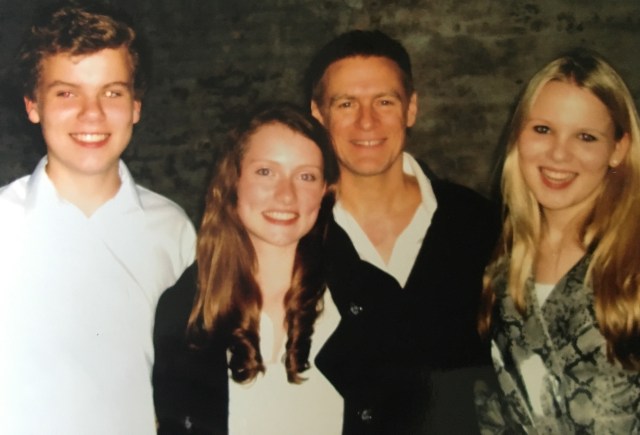
Mr Adams turned out to be very supportive of the Academy, as he lived in Chelsea. My children, then in their teens, were waiters at an event at his home. Mr Adams was fantastic with the junior waiters, all children of committee members. 

FullSizeRender

The children with Bryan Adams. 

Today I have a charity dinner for International  Justice Mission, so we have to stay up in London  for Friday night, which is out of our routine. At lunchtime, I am having lunch with another Aussie Sheila, posted to London, Gill.