Day 45

Yesterday we caught up with old friends, the Clarkes, at Austi Beach café for brekkie (breakfast) across the road from Austinmer Beach – lined with mature Norfolk pines like sentries– just down the road from Coledale. Like many of the trendy cafes that have replaced the greasy spoons of my childhood (selling deep fried fish, chips, hamburgers, and scallops – potato cakes and not the seafood), they sell the typical fresh produce that Sydney cafes now celebrate. Geoff had sourdough toast with mashed peas and poached eggs. I had banana bread and a detox juice. It was another sunny day and we sat outside.

FullSizeRender

All Aussie men know how to barbie

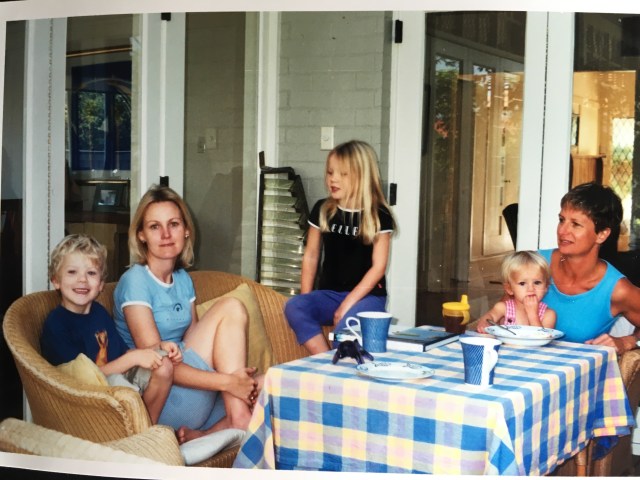
Rob and Kylie were at Macquarie Uni with me and then Rob, within a stone’s throw of graduation, landed up heading Leo Burnett, Australia (advertising) as CEO. His star has continued to ascend and he is now COO of Aussie Rugby. Kylie, a solicitor like me, has always been a part of the Mosman, North Shore (upper class, if Aussies have one) landscape. She grew up on the middle harbour foreshore and now Rob and she have a house right on Chinaman’s Beach, just before the Spit Bridge. History repeating itself in a good way.
FullSizeRender

With Kylie and the children

We hooked up in London when I first arrived in the late 80s and even after they downed tools and kackadoodled back to Sydney, we kept the fire of friendship burning, staying with them on our trips Down Under. Sometimes we visited her parents ‘weekender’ in Palm Beach, but think ‘Kennedy’ type complex, rather than the fibro Potts holiday habitat. All sandstone with a large courtyard in the middle and bang smack on the crest of the beach. The soap Home and Away is filmed around there. Palm Beach is where the good and the great of Sydney play. It’s where Tom Cruise Nicole Kidman holidayed when she wasn’t a resident.

Kylie was full of news and somehow we got onto the subject of Aussie musicians, whose fame, sadly, had rarely left the Aussie shores. She was a huge fan of Richard Clapton’s, aka black t-shirt man with black hair’s, music. Richard’s famous songs: Girls on the Avenue, Best Years of our Lives, Down to the Lucky Country etc.

Being a bit of a celebrity stalker myself, I could savor the story she laid out for us.

She had been at a ‘ladies who lunch’ charity lunch at the Governor General’s House at Kirribilli (residence of the Queen’s rep in Oz) and was tottering along in her glad rags to the bus stop in Neutral Bay, when she almost bumped into the man himself, Richard Clapton. The muso was laden with multiple plastic carriers of supermarket food – for home – not a gig. Not the sort of thing you expect a rock star to be doing on a typical weekday arvo (afternoon). It just so happened that she and Rob had recently crowd funded a part of his upcoming new album, to be recorded in Nashville. In return, Rich had agreed to come and play a short gig at their home on the foreshore.

So with a couple of glasses of champagne under her belt, Kylie approached him and explained that through her crowd funding, she had a stake in his new album. And that he would be gracing her home with his rock star talent. I of course suggested that it would be mega if he performed on the harbour itself of a floatie – boat, pontoon – of some sort.

So if you happen to be sailing off Chinaman’s Beach and notice a chubby, black haired and black attired man on a pontoon, belting out music, you will know it is indeed Kylie’s new bestie, Richard Clapton.

Today the weather has turned. It is stormy and I can see big swell approaching the coastline. I can see it from where I am typing this – majestic.
Day 44

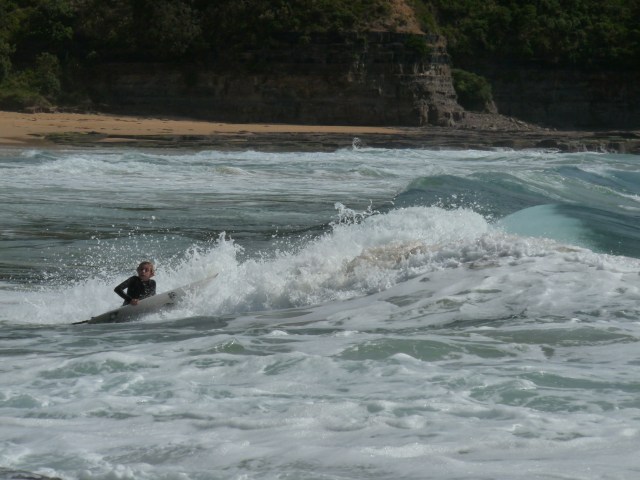
Yesterday, we headed to Bulli beach, as it has a nice even swell when other beaches can be rough. I saw some young grommets surfing off the headland and it reminded me of Shaun at the same age.

The thing is…my brother Shaun was what you would describe as the ultimate ‘Adventure Hero’. Before that, he was ‘Adventure Boy’. He was always up to mischief with Stephen Crundwell, the boy next door. The ‘Adventure Boys’ high jinks were never malicious, they wouldn’t hurt a blue-arsed fly, but nevertheless, they mucked up – got up to things that would make a mother’s hair turn grey overnight. Bev’s did.

They hero worshipped Evil Knievel, the 1970s motorcycle stuntman on telly, who broke almost every bone in his body performing crazy stunts – like revving up and then, full throttle, flying through the air over 10 double decker buses (Wembley Arena). He often crashed and burned. It was painful to watch. The boys were ants in their pants, wriggly worm, kind of boys, but they would sit as still as statues when Evil was on telly.

One day, Shaun and Stephen had a bright idea. They could do one of Evil’s stunts. The Crundwell’s pool was bigger than ours. They had an oval shaped above ground pool with wooden decks on the sides and a thick PVC (plastic) blue lining. The Adventure Boys poured petrol on the water, lit the petrol so there were flames leaping into the sky and then they rode their dragster bikes (shaped like Harley Davidsons) along the decks and launched themselves through the flames. They then swam, unscathed, to safety in the deep end. Mrs Crundwell spewed (blew a gasket) when she saw the post-stunt devastation. The flames had melted the blue lining above water level. The Adventure Boys hid for days.

In his early teens, Shaun climbed over the Sydney Harbour Bridge at night with Wilma’s son, David, from the farm – before it was open to the public.

Shaun was also a scientific geek. He once set up his prized chemistry set in the hall. One day when I ‘hated him’ for not letting me watch my favourite American telly shows, The Brady Bunch or The Partridge Family (starring David Cassidy), ‘religion’ to me, I smashed it up and mixed up all the chemicals. He pinned me against the wall and threatened to punch my guts out. Sibling warfare.

When I went to use the kitchen blender, I would sometimes find remnants of gunpowder.  Unbeknownst to my parents, Shaun was working on a canon. He used to strap it to his little stunt motor bike and let it off in deserted canals. The temptation to show off to us grew too strong and when he was about 14 he said to Dad, “Hey Dad, do you want to see how my canon works in the backyard?” Well we all went out to watch the demonstration. The wick sizzled slowly and finally “Kaboom”, the canon ball was released, the garden was alight and the back fence fell over. Stan hollered, “Bloody hell son. What will the neighbours say about the fence?” But under his breath as he walked away I heard him mutter, “That kid is a chip off the old block!”

When Shaun started surfing, the bigger the wave, the better for him. He appeared home one day with a gash between his eyes, where his face had met a reef. He learnt to scuba dive and would descend deep below the surface to the dark depths at places like Jervis Bay, further down the south coast, to explore ship wrecks. He swam with sharks at Manly Aquarium. He was told to keep his hands glued to his sides so that the sharks wouldn’t snack on them.

Attachment-1

Shaun was a grommet (the name for a young surfer)

Stan, Bev and I went to watch him and then we went to the local Greek restaurant for non-Greek food – steak, chips and peas. At the time most of the European immigrants, the Greeks and Italians, owned the diners and served Aussie food. Crazy! The other immigrants, the Chinese, served Chinese food. Not crazy. 

Today we’ll catch up with Rob and Kylie Clarke, who live the Australian dream on the North Shore in Mosman.

Day 43

Yesterday we headed inland, southwest, to Berrima in the Southern Highlands, to visit the Bendooley vineyard and the sandstone bookshop/restaurant/wine tasting bar, owned by the Berkalow family. They are the equivalent to the Waterstones in Britain.

I know in my head that Australia is a big empty country and that the coastal capital cities of the states that constitute the Federation of Australia (formed in 1901) are where most Aussies live, but when your eyes see the vastness first hand, it knocks the breath out of your lungs. We headed out on Picton Road to the Old Hume Highway. Mile after mile of un-populated bush land, filled with gnarled, peeling eucalyptus trees and dense, green vegetation. The earth almost rust red (the iron content).

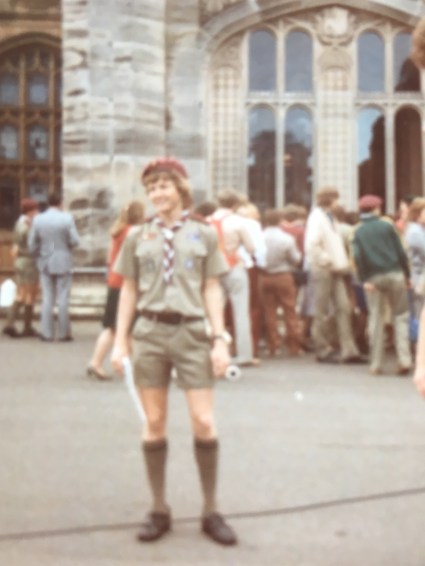
It reminded me of Shaun’s days in the Scouts. He spent many weekends in the Aussie bush: camping, abseiling, trekking, climbing and descending into black holes in the earth. He could give Bear Grylls a run for his money – seriously! He went through cubs as a boy, then scouts and then Venturers– aged 14 to 17 – completing the Queen’s Scout Award over that period.

FullSizeRender-2

Shaun receiving the Queen’s Scout Award

The Award is reputed to be more taxing that the Gold Duke of Edinburgh. And in the 70s, there were no mobile phones, no GPS, to get you out of a tough spot if you got lost or had an accident in the bush. You just have to find a way out – use your wits.  Plus in the Aussie bush, there are deadly spiders and snakes. It was a proud day when the family went to Government House, down by the Opera House, to watch the governor present the Award to Shaun.

Shaun told me about the first, incredible, unaccompanied trek he did, aged 15, with his two Venturer mates, Mark Houghton (father was Skip of the Scouts) and Dave Cantlon. Bill Stevens, the leader, literally drove them into the Kanangra-Boyd National Park, SW of Sydney and left them there. They had provisions and tents in back packs. Each boy was to act as guide for one of the three days and had a topographical map of the section he was responsible for – so a map and a compass was all they had to trek for miles. At the end of day 3 they were to report to the police station in the park and then catch a train home.

The first night it poured with rain and they got soaked. The first day they had to scale sheer cliffs as they were slightly off the path. If they had fallen, they would have pegged it. The second day they were in thick vegetation with no tracks. It came to day 3. Mark had bought the wrong map. It was a large scale map of the whole area, so the terrain was impossible to read. They had to climb a waterfall and if they had fallen that time, they would have pegged it again. Somehow they managed to go the right way and when they could barely walk at 10pm, they found a couple parked randomly in a car and they drove them to the police station. The later found out the last day should have been a two day walk. When the policeman saw them, he casually said, “I was wondering what had happened to you boys.” Did he think to send out a search party???

Shaun lived for adrenaline, whether scouting or otherwise. He surfed; scuba dived and got up to a lot of mischief as a boy and young teenager. He was a scientific geek too. I will tell you more about that tomorrow. 

FullSizeRender-3

Shaun teaching Geoff to fish

My brother Shaun is the smartest (he came first in his Masters of Theology in Australia at the age of 28), the bravest, most practical, Aussie bloke I know. And a blonde Tom Cruise in looks and mannerisms!!!

Today, yes, we are going to swim in the surf again. I love it. My favourite thing to do! It never gets boring! The weather has been stable and between 21 to 25 degrees. It’s autumn.

Day 42

Yesterday Mum showed me the Order of Service for my Uncle Quentin, her brother, who recently died. He was a kind and gentle man. She lost her sister, Marcia, 40 years ago. So it was a tough blow to lose Quentin. They grew up in Ashbury, a suburb slightly west of downtown Sydney.

Marcia became a country girl when she married Noel and moved to Wagga Wagga. She was true to her roots, as my grandmother, Vera Jones, was part of two large rural clans from County Monahagn, Ireland, who left what they knew, to go to what they did not know, Australia. The potato famine forced them to take their chances and head to Victoria. Vera’s grandfather, John Hall, arrived in Melbourne in 1859, with is wife Mary and 3 daughters under the age of four.

FullSizeRender-1

Next to Auntie Marcia and her lamb

The trip took 140 days and you can imagine the lack of sanitation, poor food and cramped accommodation. They went from Melbourne north to Clunes, where gold fever had gripped the town since it was discovered in 1851. Together they went on to have 9 children in all. Vera’s father, Robert (my great grandfather), was number 7.

The family moved around, but finally settled on a dairy farm in Undera, in the Goulbourn Valley, SW of Sydney. Robert married Martha Martin (also of County Monahagn). They were married in Clunes Presbyterian Church on 22 February, 1897. Robert and Martha stayed on the dairy farm in Undera until both parents had died and then they headed to New South Wales in 1908.

They were initially based at Uley Station, Ardlethan, not far from Wilma’s farm, Iventure, in Talimba, near West Wyalong – the place I visited during my teens. That was where Grandmother Vera was born on 7 June, 1910. She was the last of 8 children.

FullSizeRender

My grandmother with bald me

Four of Grandma’s five brothers fought in WWI. Miraculously they all survived. They were eligible for free land in a ballot, like the lottery, for fighting for the Mother Country in Europe. The eldest, Cecil, won a bonza place, Elcombe, near Reefton in the vicinity of West Wyalong. Tod, Wilma’s Dad, won a place nearby and the entire family worked together, until all the boys had secured farms. That was when their luck turned and they made fortunes on the “sheep’s back” – merino wool.

I have vivid memories of my time going to Marcia’s farm when I was a young girl. I remember Dad and Mum spontaneously driving us on treacherous roads overnight – Shaun and I slept on a mattress in the boot. Making plasticine food on her porch. Watching the grown ups dance to music played on a record player. Eating a cocktail onion which Marcia pretended was a sweet. She loved practical jokes. 

So today we will head into the interior towards Wagga Wagga, in the same direction, but some miles short of it.

Day 41

It was my mother’s, Beverley’s, birthday over the weekend. Since my exile to Britain, I’ve only celebrated one other birthday with her in 27 years, so it was “beaut” to be able to celebrate her life together, with my Aussie family. So this will be an extended blog in her honour.

My parents, Stan and Bev Potts, met and married when they were crazily young, when they worked for the same company in Sydney. Bev was the boss’s secretary and Dad would make deliveries from time to time. Bev clocked him, because Dad was drop dead gorgeous. Mum was too: but he had that olive skin and dark, curly hair thing going on. It was virtually love at first sight. They had their ups and downs in life, one big valley and then they were happy in the twilight years, very happy.

FullSizeRender

Stanley and Beverley on their wedding day

She and Dad, Stan, before he died, lived a “beaut life” in the family house on Cater Street, in Coledale, on the Illawarra peninsula, just beside the sleepy train station. From the deck you can see the swell of the sea, lit up by the sun as it comes over the horizon at dawn. At the end of the street, down the hill, is a prehistoric rocky headland and if you’re lucky, you might see whales in the “warder” (how Aussies often pronounce water), with babes, on their migration north. Or, even dolphins frolicking in the frothy sea, side by side with surfers.

Once my son, Hugo, was body boarding with his cousin, Ryan, and dolphins played with them, swimming and leaping over them. Hugo did say he was petrified when he saw a group of fins approaching, but fear turned to ecstasy as the ‘dolphin gymnastics’ played out.

My English family adored the house in Cater Street, being a home away from home. It was perfect for our regular visits. There was a verandah three quarters of the way around the perimeter. The Wilmots had a separate annex with two bedrooms, a bathroom, kitchen and sitting room, but we could wander along the verandah and pop in any time to see Dad and Mum. 

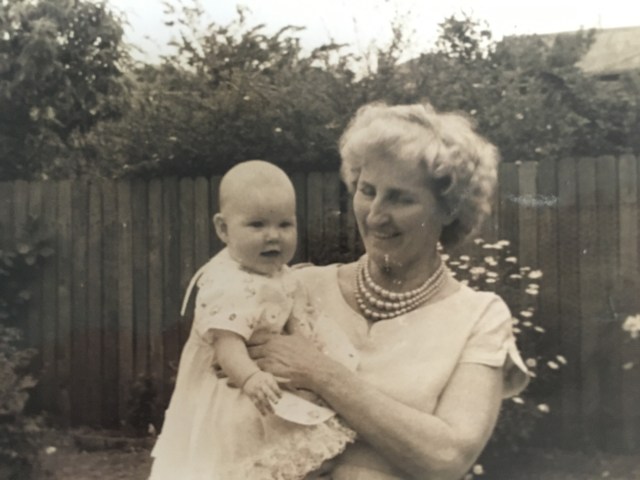
My children, Anna and Hugo, loved spending time with their Aussie grandparents. Grandma, Bev, is so like me to look at, she always felt familiar and close to them. She was always gentle and kind – had time to talk to them – patiently teach them card games like canasta – point out local animals –she is crazy for animals –even saving spiders when they wandered indoors – not the deadly ones. Stan, well he was a legend, taking cooking apparatus to the beach and cooking hotdogs for us all. I would chuck my body board and towels on the verandah after a day at the beach and they would be de-salted and returned to the boot of the clapped out station wagon –the beach car – ready for the next day’s adventure.

FullSizeRender

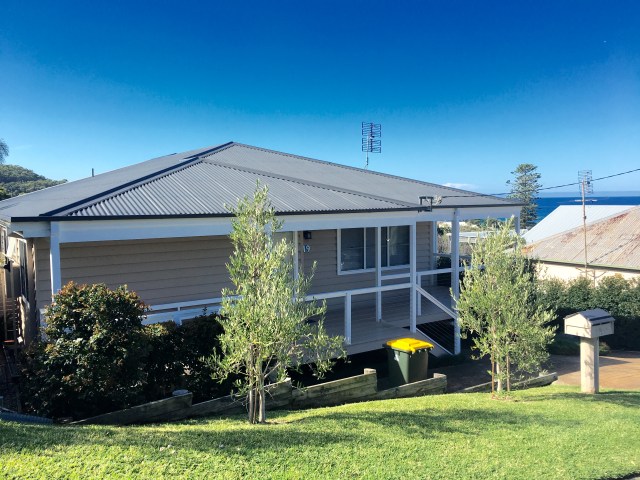
The family house on Cater Street

Life in Oz, on the Illawarra peninsula, is exotic and different. 80% of animals and plants, fauna and flora, in Oz, are unique to the continent. Possums pounded on the corrugated iron roof at night and rosella (red and blue birds) snuck (stole) the cat’s water. My children fed them nibbles by hand. The steep escarpment hid the heat of the sun in the west at the end of the day. When Dad died, the house got a bit much for Mum, so she moved to somewhere smaller down the road in Thirroul, just before Bulli. D H Lawrence lived in the street while he wrote his book ‘Kangaroo’.

When we caught up with Jonah, second son to my brother Shaun, he had survived his night at the shack on the beach near Scarborough on the first night of our visit. While Geoff and I were curled up in The Creek House (eco house-AirBnB) near Sharkeys beach, the wind was dancing around the inside of the shack, keeping Jonah and his mate up most of the night. Next time I saw him he was off with the same mate to find the source of the creek adjoining their house at the base of the steep, overgrown escarpment. He later told me had spiders dropping onto him as he crawled through narrow passageways. Funnel webs and red backs are deadly. Black snakes and brown snakes are not fun either. You want to avoid them. Adventure as a 17 year old, testing the limits, is his priority. It was the same for my brother, Shaun, at the same age. More on that later.

I told you in my last post about growing up in the St George region in the 60s and 70s, a zillion miles away from the life my children had in London, geographically and metaphorically.

It was unfettered and free like Jonah’s. As a kid I was feral out of school – tamed teacher’s pet in school. I ran around barefoot on the hot tarmac of the roads and on the spongy buffalo grass. The soles of my feet were rock solid and I barely registered the bindi-eyes, small thorns, in the grass as I raced around. The mirrored back-to-back rears of houses had wooden fences as boundaries. There was a continuous horizontal plank about a foot from the top, which held the vertical posts together. Rather than go right around the block to see a mate in the next street, I would clamber up barefoot, walk along the plank and drop into their backyard. Maybe stay for a swim if it was belting hot.

Going around with bare feet is part of being an Aussie kid- it doesn’t mean you’re poor and can’t afford shoes. If you live near the beach and you’re heading there, you leg it in your (cossies) swimmers, and a towel under your arm – no shoes. If you’re a grommet, a young surfer, you leg it in a wet suit and with a surfboard under your arm – no shoes. You ride your bike barefoot.

It now initially shocks me in Oz when I see shirtless and shoeless men get out of cars and wander into shops. Or bare foot women in shorts and bikini tops. Oz is very relaxed outside of the CBD.

Tomorrow I’ll tell you about how Mum’s family from County Monahagn in Ireland, bravely might I add, set sail for Australia. Oz was initially a convict settlement for the Brits, but they were free farming settlers.

More swimming and catching up with the relos today.

Day 40

Yesterday we hit the surf at Austinmer. It was heavenly, catching waves, diving under the white wash, tasting the salt. I always feel youthful in surf. Like the young girl at the Weekender, up near Gosford, where Stan’s parents had a holiday home by the sea. I forget I’m in my mid-fifties.

I didn’t grow up with direct access to the sea. The St George region wasn’t far though, but during the weekdays we were landlocked. Swimming was in chlorinated pools in Bexley North or Kingsgrove, the next suburb, either in backyards or at the Olympic pool on Preddys Road, where the Collins family lived.

Our street Laycock Street (named after Hannah Laycock , the first settler of the area, who was granted King’s Grove Farm – in 1804) was a typical neighbourhood. The area once had teeming wildlife: kangaroos, wallabies, koalas and possums jumping around the bushland and platypuses swimming in Wolli Creek. That was all long gone and replaced with a grid of monotonous red brick dwellings, with a garage, a driveway and a backyard (garden) and a small front yard. Beyond the front fence, there was more grass, which you were responsible for mowing, even though it was government owned. Over the years, some families put on extensions or clapboard second stories, called cape cods. Some had in-ground pools or the cheaper above ground ones, with blue plastic liners. We had an above ground one. It was behind the garage, next to the mulberry tree.

And then there were our neighbours… Mr Tierney was pretty deaf from the First World War in Turkey. He loved my dog Skipper and gave him a roast on Sunday. Mrs Smith was elderly too and used to wave at all the kids who tore past her front fence like tornadoes. Jenny, down the street towards the park (common) was my age, but she didn’t play outside much. She pulled a kettle over herself when she was a toddler and had horrific burns. Her parents were overprotective. The Catholic family across the road – the Kregans. There was a big divide between Catholics and Protestants in those days, as if we didn’t share the same Christ. Mr Kregan used to yell his head off at his wife on Sunday mornings. Dad used to mow the lawn to drown out the din. The Greek family across the road, who grew wild passion fruit along their fence and gave you sugar coated almonds when you visited. Their home was well ordered and civilised.

IMG_3927

The Creek House from where I will be writing

But the family we moved in and out of, without boundaries, was the Crundwells, right next door. The four kids were adopted. Christine was my age. She was a beautiful Polynesian. She was born with two digits on her upper thumb, one being removed at birth, leaving her thumb looking like a boomerang. Stephen was my brother’s, Shaun’s, age and had a cluster of moles on one cheek, which was a medical mystery periodically studied at the Children’s Hospital (equivalent to Guys in London). We didn’t give these traits a moment’s thought. They were our best mates and we ran around with them in a pack.

Mr Crundwell was a civil servant and loved classical music. He never went to the pub like the “working” men, like Stan. Mrs Crundwell was a teacher. They drove a Combi van. They were Methodists. We abbreviated their names to Mr and Mrs C – an Aussie trait –a typical way of addressing the parents of your mates.

Mrs C’s problem was that she had a really blazing temper –she was a hollerer. You instantly knew when you turned up at the back door unannounced whether to tread warily or not. If she was on a rant, the family would normally suffer in silence, but occasionally, Mr Crundwell would have a gut full and put his foot down. Then he would bark back out orders to clean the house up. The house was always a bit of a tip. Sometimes he’d even say, “bloody”, despite being a Methodist. Then you knew he was really fuming. Then Mrs C would become as meek as a lamb. She’s clear up and Mr C would retire to play The Nutcracker on his record player. 

Mr and Mrs C let me use their Encyclopaedia Britannica whenever I wanted, which was a lot, as I was good at school. When I was 10 I took an IQ test with the rest of my class and I was asked to attend an Opportunity C school in Hurstville, for academically gifted children. It was the same one that Clive James attended decades before, but Bev took advice and thought I was better off staying at Kingsgrove Primary.

Today, we will go for a surf again and then catch up with the relos for the afternoon. It’s Mum’s birthday on Saturday so we’ll all be together for a change, except for Anna and Hugo, who I miss.

Day 39

The plane trip yesterday from Singapore to Sydney was substandard. The in-house entertainment broke, the food was horrible and I was not a happy Sheila. You usually do better Singapore Airlines!

We arrived in Sydney late afternoon at sunset. As the plane was preparing for touch down, I could see Sydney below me in the sunshine. The harbour was filled with sail boats of all sizes and shapes – flanked by the sail-like Opera House and the Harbour Bridge – sturdy, strong and true. I was tired, swollen and pale. But excited to be back.

It was my turn in the queue to approach the immigration officer.  He welcomed me with a big grin and as he stamped my passport he said, “You have a beaut stay love.” Things were looking up.

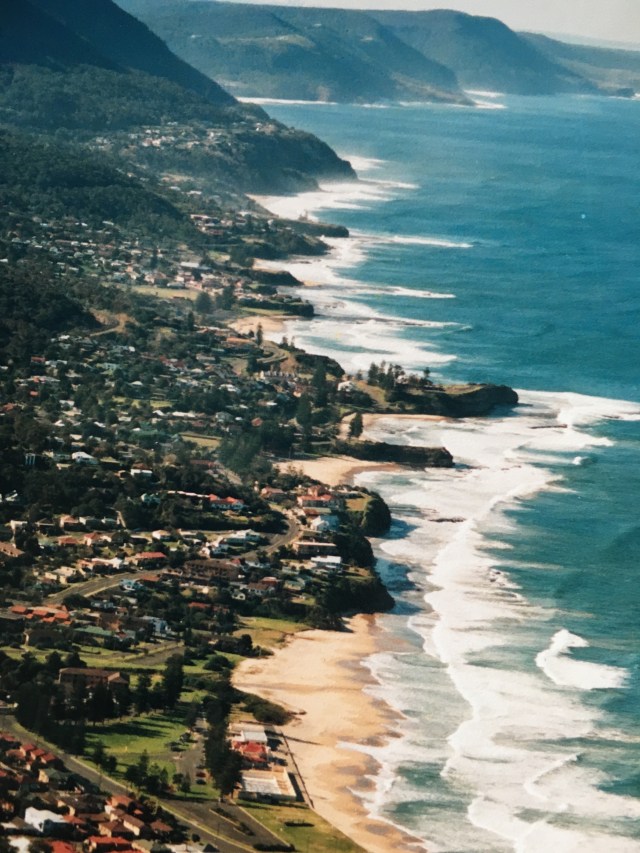
My sister in law, Wendy, was there to load us up and drive us an hour south of Sydney to where the Potts clan live, now minus Stan the Man. Dad was always the one to collect us from the airport and I miss him. The Potts family live on the Illawarra peninsula, which spans from Stanwell Park to Bulli, just beyond the Royal National Park. The whole of the Pacific side of Oz is littered with jewels of beaches. But the Illawarra peninsula is particularly spectacular as you have the escarpment on one side and the sea on the other, so that there is only a smattering of houses between. Only so much development can happen, as you are blocked from building west.

FullSizeRender

The Illawarra peninsula

So from the airport you pass through the St George region where I grew up in the suburbs, over the George’s River, through the Southern Shire, then you leave the ugly 1960s/70s architecture behind and hit the bush land of the Royal National Park. Finally you turn left towards the sea and at Stanwell Tops you descend dramatically from the top of the escarpment to start the winding drive down the coast to Coledale, midway on the strip.

Shaun and Wendy, my brother and his wife, were visionary and bought land in their early 20s, shortly after they were married, when it was cheap and the area was filled with miners’ cottages. Their mates, Brett and Gillian Davis, shared the plot and together they built two double storey, clapboard houses, with a communal garden, leading to a creek and a boomerang’s throw to the beach. My parents, Stan and Bev, upped sticks and joined them in 1999 and moved a few streets further south.

After a very long journey from London we were finally reunited with everyone. It had been raining and the smell of the eucalyptus was in the damp air.

My children have enjoyed many interludes from urban life in London in this idyllic spot, running wild with their Aussie cousins and the Davis’ children, first in the backyard and then further afield. Startrite shoes and smart clothes gave way to swimmers and bare feet.

The middle cousin Jonah was missing when we arrived. He’d gone in search of a deserted shack up the coast with a mate. They were going to move in for the night, catch fish and grill them on a campfire.

That is the Aussie childhood for you, on the outskirts of ‘development’.  Adventure in spade loads, the sort of stuff Bear Grylls is famous for. That is the sort of freedom that I had growing up in Bexley North and I’ll tell you about that while I’m in Oz. 

Today we will hit the surf and have some good Aussie tucker – grub – food and catch up with the relos.

Day 38

It is 5.30am in the morning. I am typing at Changi Airport in Singapore, about to board the next plane to Sydney, where I was born and grew up in a suburb called Bexley North, not far from where Captain Cook landed his ship ‘The Endeavour’ in Botany Bay, Australia, in 1788. That is ironically where the airport is located on the north of the bay.

Bexley North is in the St George region, made up of the cities of Kogarah (where a famous Aussie, Clive James, who also ended up in England, was raised 20 years before me), Hurstville and Rockdale. Further past this region is the final bit of Sydney to the south, the Shire, not Lord of the Rings, but home to Cronulla beach. This is where my brother Shaun learnt to surf.

I can feel my throat tightening as I type. It’s always an emotional trip, this next leg of the journey. I am not really returning home. I don’t live there anymore. I am just visiting. I will have to leave. And yet it is pivotal to my identity – who I am in the guts of me.

Yesterday we had a ‘Singapore Sling’ (cocktail) and sandwich at the Long Bar at the Raffles hotel. You can shell peanuts and chuck the shells on the floor. Little birds fly in and out, feeding on the crumbs. This tradition has been in place for a long time.

The hotel is an old colonial beauty, the matriarch of Singapore. She has watched the city shake off its colonial roots – Asian progress –without herself changing. She is like an elaborate wedding cake with red icing on top. If you don’t see anything else in Singapore, it is worth paying this great lady a visit.

I’ve been home to Sydney many, many times since the birth of my children, Anna and Hugo in 1994 and 1995 respectively.  I wanted them to see my side of the story – show them the greatness of this unique island, which is also classed as a continent.

But before Anna was born I only went home once, once in five years or so. I went walkabout in England and got lost. I forgot my roots. The Kangaroo was trying to camouflage herself as a pheasant.  But the didgeridoo was calling me back to my senses – somewhere there was a corroboree dreaming me home.

So when Anna was a baby we took her back to Oz to show her off to the relos (relatives).

After 18 exhausting hours on the plane, I caught sight of the Australian coastline ahead in the distance from my window seat. It caught me by surprise, knocked me off balance. I could see the surging waves relentlessly pounding the uninhabited section of virgin coast, just west of Darwin, at the top of Australia. There was no sign of civilisation for miles.

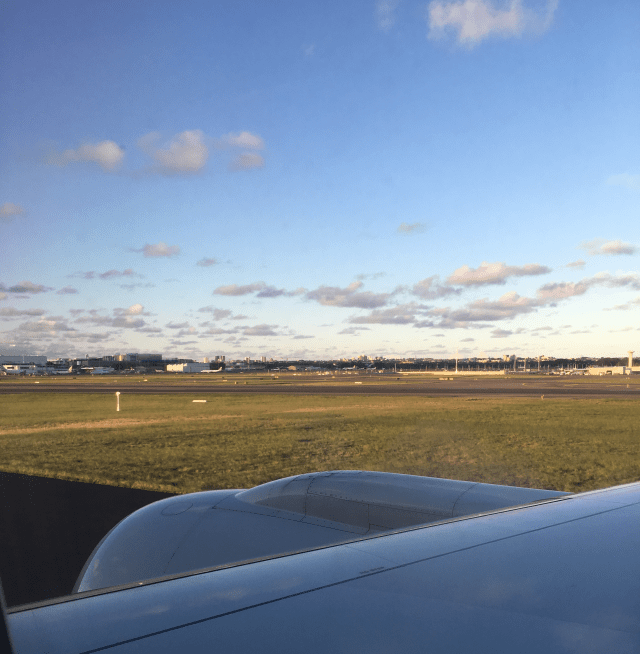
Touchdown at Sydney Airport

Touching down in Sydney airport

As we left the coastline behind and it sunk in that we were in Australia (albeit above it) something broke in me, a tension snapped and I was overwhelmed with nostalgia and loss. I started to cry and I couldn’t stop. We passed over miles and miles of red desert, my sunburnt country, before finally reaching the fertile band hugging Sydney in the east.

As Bill Bryson observed in his book ‘Down Under’ “Australia is, after all, mostly empty and a long way away.” It’s population nudges 23 million. Not much given its area is 2.97 million square miles. China is 3.7 million square miles. China has a population of 1,357 million. You can do the math. Lots more people inhabiting China.

Geoff patiently held Anna and let me get on with it – get the sadness out of my system – from setting foot ‘over’ Australia to touch down.  The staff on the plane looked concerned that there was a nutter on board. I wasn’t insane. It was just that the Kangaroo was coming back. She hadn’t disappeared forever. She’d just disappeared under a wave, holding her breath.

So today I will be up in a tin can in the sky, once again, with Geoff. It takes a day out of your life to reach Sydney from London. It’s worth it as I “Come from the land Down Under, where women glow and men plunder, Can’t you hear, can’t you hear the thunder…” (Men at Work song). I can hear the thunder. It is the great country of Australia calling me and we’ll be there soon.

Day 37

We had dramatic thunderstorms yesterday and more are due today. In between it will be either cloudy and around 30 Celsius or sunny and around 30 Celsius. The temperature is constant, no matter how changeable the weather.

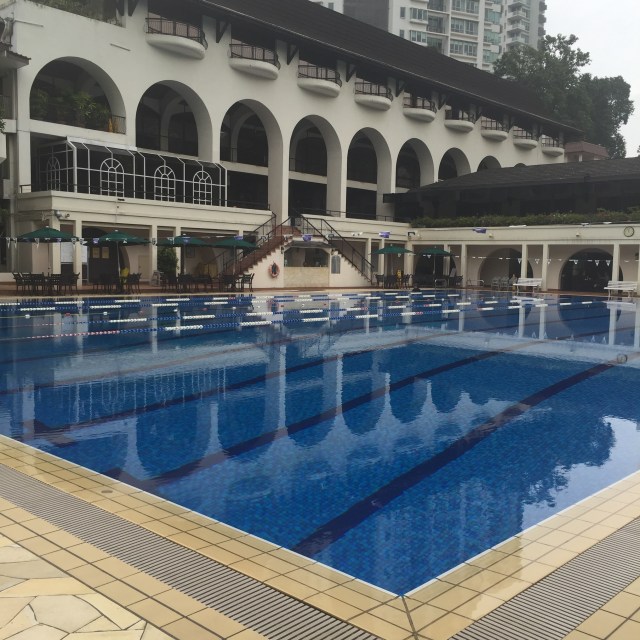
We spent yesterday at the Tanglin Club, which we are allowed to visit on a reciprocal basis due to our Hurlingham Club membership. You scratch my back, I’ll scratch yours – you get to visit other clubs around the world as long as they can visit yours. We’ve done so in Sydney, Bermuda, Paris and Hong Kong. It is an opportunity to observe the locals at play.

Geoff learnt to swim at the Tanglin Club when he was 2 years old in 1955 (yes that makes him 63). Tony and Eve, his parents, relocated to Singapore from Accra, Ghana, where Geoff was born and spent three years here. Tony was Regional Secretary of the Commonwealth Development Corp. (which was like a British government backed investment bank). He was part of the colonial age. His older brother, Tim, and his younger sister, Rachel, were also with them. The older two, twins Jonathan and Miriam, had been sent to boarding school in Britain. The younger bookend twins, David and Patrick, were yet to be born. They were born in Lagos, Nigeria. It is a family setup that I could never contemplate, given that as a child, I was never more than 10 miles from my parents.

daddy swimming

Geoffrey in 1955

The Tanglin Club in the 1950s was a British expat haven. Its formal dining room is still called The Churchill. Geoff can remember floating to the bottom of the pool and seeing Eve coming down to the depths to retrieve him. He is not sure to this day whether he was actually drowning. Eve obviously thought so! It is striking, over the period we have been coming to Singapore since the early 1990s, how diverse the membership of the club has become: Chinese, Indian, American, Australian, Kiwis, but still a few Brits. The Chinese take tea inside in the cool. The Brits sit outside sweating like pigs in the sun. What is the saying, “Mad dogs and Englishmen stay out in the midday sun…”

IMG_0159

The Tanglin Club pool where Geoff learned to swim in 1955

The Japanese occupied Singapore during WW2. After the war, it reverted to British colonial control, with increasing levels of self-government being granted. It became an independent republic in August 1965; 7 years after the Wilmots had left by ship (through the Suez Canal) back to Kent in England, before onward travel to Lagos.

Singapore is an unadulterated success story in economic terms. When the British handed over the reins it had a lot of social problems, but it has gone from strength to strength, growing 9% a year according to one source. Every time we’ve visited, something new has appeared on the landscape, more land has been reclaimed from the sea, another monster skyscraper is up, a grand prix track has appeared where there was water, a casino, a nighttime safari, another  ‘London Eye’. The shopping is on a stratospheric level. What you see above street level is the tip of the iceberg. There are floors upon floors underground of cool, air conditioned retail outlets.

Is it charming? In a word, NO. Most of the colonial buildings have gone. Some have been turned into hotels like the Fullerton, Goodwood Park Hotel and Fort Channing, but the tigers that once roamed the city and the monkeys that swung from trees when the Wilmots were here are long gone. As are the smell of spices on the hot breeze. Sentosa Island is like a pretend film set. The sand has been imported and the infrastructure looks rather synthetic, like a toy city.

Nevertheless, as a stopover, it is unbeatable for comfort and efficiency. Within an hour of the wheels touching the tarmac at Changi Airport, you are in the swimming pool of a very nice hotel.

Today we will go to Raffles, the grandest old hotel of them all.

Day 36

The weather today is hot and humid. I am in Singapore, with Geoff, on my way to Australia. The first time together, without Anna and Hugo.

We have travelled to the Equator in a ‘tin can’ in the sky. Have you had the dream where you can fly like an eagle? When Geoff dreams, he is like an Avatar – he can just effortlessly launch off a stable platform and glide, adjusting his path with a subtle change in body direction. No such luck for me! I have to flap and flap like a helicopter until enough energy is generated for lift off.

It is extraordinary that humans (or ones that can afford it) can fly around the world today. And that is a point in itself. In the 1950s and 1960s, plane travel was reserved for the jet set, super rich. It took a number of days with multiple stopovers to reach the Orient from London. Now, if you have tons of cash, you probably will turn left to first class. Otherwise, you turn right, passing through rows of, often empty, business class seats, until you finally make it to economy. That is where we always head. Business class tickets for all four of us on a regular basis over the years would have amounted to the equivalent of the cost of a house.

The first couple of times we flew to Oz, with tiny children, we flew all the way through, with an hour stopover somewhere. The equivalent to hell on earth. In those days, there were screens that would lower down from the ceiling and play one film for all. The children were too small to see the screen. We switched to Singapore Airlines, as they were one of the first to install screens in the back of the seat in front. On yesterday’s flight, we had touch screens, giving us a choice of hundreds of films and television shows. No need for handset controls. Such progress over such a short period!

Geoff and I flew the children to Sydney via Singapore on one of the earliest Airbus A380 flights. When we saw the gigantic aircraft I froze with fear. I just couldn’t believe that it was capable of becoming airborne; it was on a massive scale. As it happened, all the technology went AWOL and there were technicians running around like headless chickens trying to get the inflight entertainment to work.

Although flying conditions have improved over the years in terms of the quality of the food and entertainment, the routine is still the same. Your seat area is initially spotless. You store the things you will need during the flight in the pouch in front of you: books, reading glasses, antiseptic hand wash (nappies and wipes when the children were little). Then you check out the films you will watch. Maybe mark them with an asterisk. Then you study the menu as if you were in a Michelin star restaurant and resolve not to eat all the extras like ice creams and cheese and biscuits and to drink minimal alcohol.

Fast forward to the end of the flight. You are distressed at the pale and bloated face staring back at you from the filthy toilet mirror. You have eaten everything on offer, the full monty. You just resisted licking the little rectangular plastic plate after your main course. You consumed alcohol, not just water. You are so sleep deprived by the end that you are almost insane. When you leave the plane your area looks like WW3.

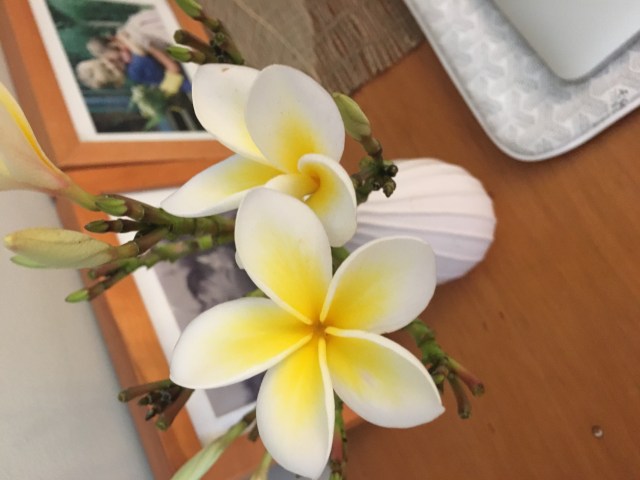
And then balmy, exotic Singapore. What a relief to get off the plane. Feel human again. See the exotic frangipani and bougainvillea lining the motorway. I have stopped off in Singapore 27 times since I married Geoff. Our first trip Down Under was via Bangkok, Thailand: noisy (an overload of traffic on the river and roads) and smelly (of humans, spices, food and sewerage). The locals tried to sell you anything they could: a suit or dress in twenty-four hours; gems (we bought a Ceylonese sapphire for a song); exotic fabrics and pearls. I had never seen humans with missing limbs, begging on the side of the street in rags or women enticing men to come and join them ‘inside’ for a sexual transaction. It was out of my comfort zone – off the radar.

IMG_3853

Frangipani trees in Singapore and Australia

Singapore was a different story. It is where Geoff learnt to swim 60 years ago at the Tanglin Club and Orchard Road was actually full of orchards: of nutmeg, pepper and fruit plantations, not a shopping mecca. It is where I marked my children’s growth from baby to adulthood, like marking their heights on a doorway.

Today, we will swim and try to feel human now that day is now night and vice versa.