Today is overcast in Liss, but I am heading south to Hayling Island to have coffee with friends from Book Club in London, and I hear that it is sunny there.
The rest of the day I will be preparing for Geoff’s eldest sister, Mim, and her extended family’s visit to the Old Rectory tomorrow. My nephew-in-law is playing against our local team on the cricket pitch just behind our house.
Yesterday, I went to Woolbeding, a pretty Georgian minor country house near Midhurst, to see its gardens, which are open on Thursdays. It is owned by the Sainsburys, the same family that owned the supermarket chain. The National Trust look after the beautiful gardens, and the public can walk right up to the house. The owners, however, barricade the windows from prying eyes by closing the shutters.
The grounds were beautifully manicured. The vegetables were organised in attractive patterns, that made the produce look good enough to eat, which is just as well.
The National Trust has taken over a number of country houses, mainly major ones, when aristocratic families can no longer afford the upkeep. They often live in a wing and use the rooms open to the public for special occasions, like Christmas. The death duties on these places are onerous.In Australia, there is is no inheritance tax. Not the case in Britain.
Even stately homes which are not National Trust, sometimes open the house to the public or rent the grounds for special events, like the International Horse Trials at Bleinhem Palace near Woodstock. This is not a royal palace. It is a ducal palace, owned by the Duke of Marlborough. The Duke of Beaufort hosts the Badminton Horse Trials at his stately home, Badminton House, in Gloucestershire – where Prince Charles hangs out nearby at Highgrove. Dukes are very high up the aristocratic pecking order in Britain. Dad called Mum the Duchess, but sadly there was no big house to be enjoyed.
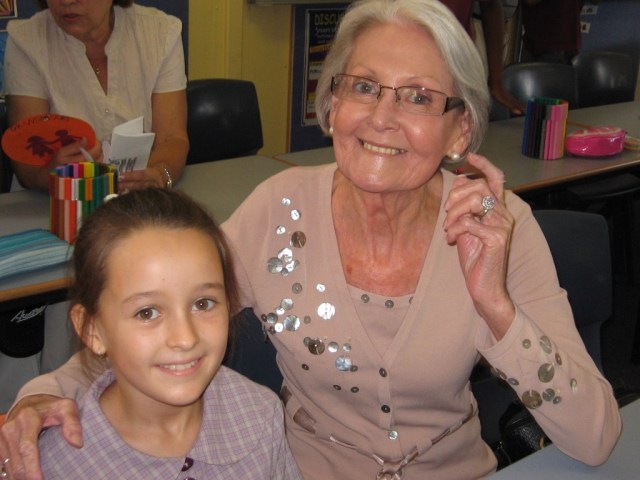
The Duchess-Dad’s name for Mum-with Sophia Potts, her granddaughter
Most palaces are owned by the Queen, and the Archbishop of Canterbury lives in one near the Houses of Parliament. He was, as I said, in attendance at the Church of England festival that Hugo and his cousins were at this week. I went for one day. It was in the grounds of a stately home.
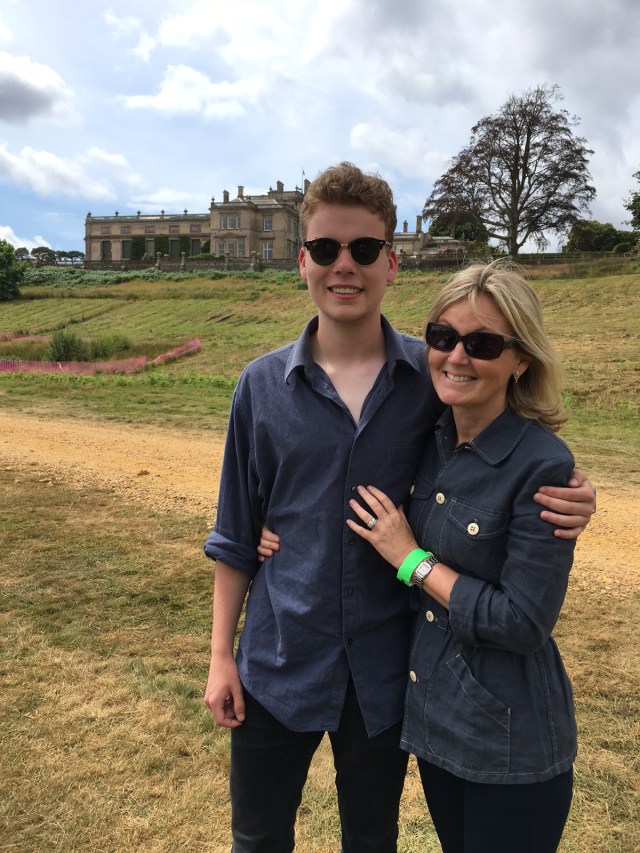
Ancestral homes rent out their grounds to raise revenue
So big whopping country houses in Britain, like Holkham Hall in Norfolk, are called stately homes if they are sometimes open to the public. ‘Mansion’ is rarely used to describe them. It is a term used in the United States, but not in Britain. A tad too showy.
Castles have defence features, like battlements, towers and often a moat. Think Windsor Castle, the Tower of London and Edinburgh Castle and are from the mediaeval period. The word for major country houses in France is obviously chateau, and it is often the case that it gives its name to a wine made in the neighbourhood.
Palladian architecture is my favourite. It is derived from the Venetian architect, Andrea Palladio. It is denoted by a symmetrical facade, often with a central portico, a columned or walled porch. I particularly like it when there is a symmetrical triangle over the portico, in the style of Greek and Roman ancient buildings.
So I better get going, so that I can start cooking.
 Diary of a Sloane Sheila