It is raining. It is a reminder that summer is on the wane. I can barely think about it.
British summer time will end three weeks into September. It is almost the end of August now.
The bank holiday weekend at the end of August is the cut off point in the British psyche; play has ended, and it is back to business. At the start of September the school year begins, and once again London is teeming, full of its inhabitants returned from their holidays. They will be golden brown and healthy. Next week Peter Jones will have queues of parents buying school shoes and uniforms. They give you a number, and they ring when you are close to being seen. They do a record trade.
Twenty eight years ago, to the day, I arrived in England: 19 August, 1988.
Little did I know that I would never, permanently, return to that vast, empty continent of Australia, with its majestic coastline, pounded by a powerful, frothy, turbulent sea. The efforts and toil of its inhabitants appear dwarfed by the water-force at the margins of their existence. The sea makes you feel smaller, less significant. When one is no longer, it will still be.
I met Geoff the day after I arrived at his family home, Stone House, an old rectory in Kent. We were married about six months later. I was landlocked thereafter.
What a change!
For my tenth anniversary of arriving, we celebrated with friends in Salcombe. I cried all day. Then I ate prawns, bought at great expense from a fishmonger, and we drank Aussie sparkling wine. But it was made better by the fact that I was by the sea.
For my twentieth anniversary I was also by the sea. I was in Crete with Geoff and the children. Anna was school friends with a striking Greek, Sophia Pia Zombanakis. She had an elegant mother, Vaggie, who was an ex-dancer, and a Cretan banker father, Andreas, who studied at Harvard like his father, Minos, and she had a younger brother, Minos, who is now at Harvard. Three generations of men at Harvard. They invited us for the day to their holiday home by the sea in Kalives.
It was a petite, extremely elegant, canary-yellow neo-classical villa. It had only a scattering of bedrooms and a small living room and kitchen. There were colourful lead light windows enticing you to the sea. The sea was almost up to the porch. You could have thrown yourself across the tiny sandy expanse and landed in the water. It was charming.
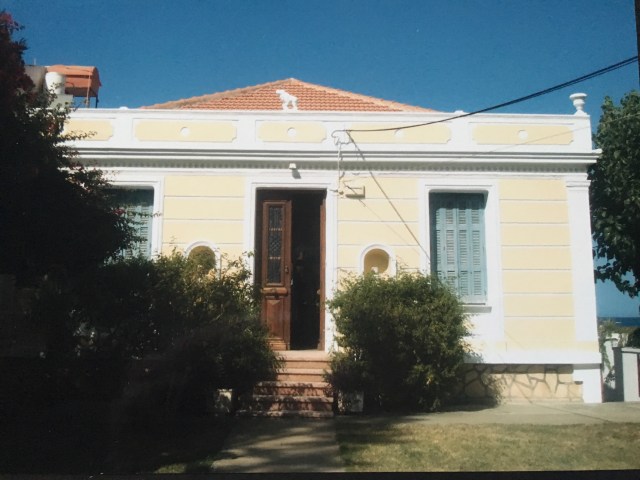
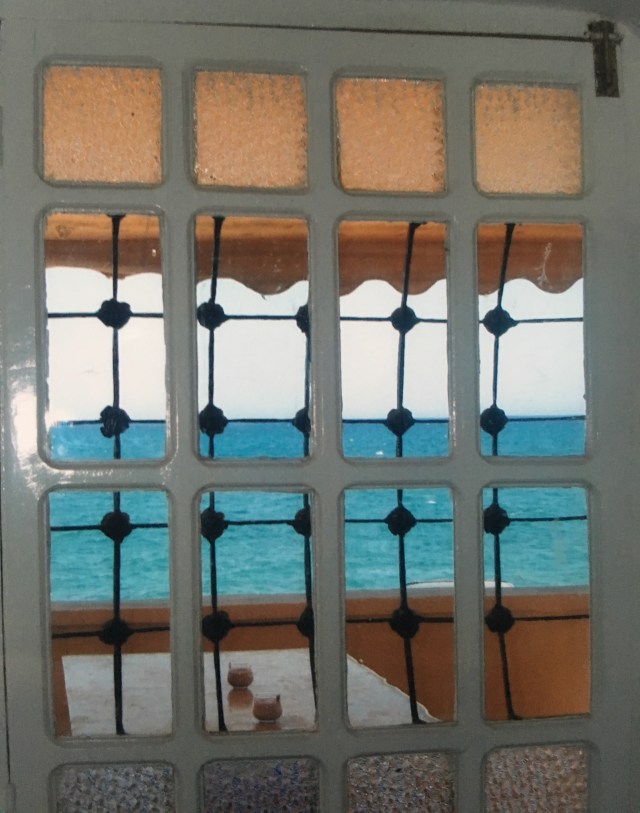
The sea was so close to the house – you could touch it
The pretty villa had been handed down by Sophia Pia’s grandfather, Minos, to her father Andreas. It had been built previously by his citrus-farming father early in the 20th century.
Minos Senior catapulted himself from this small village, leaving his humble beginnings, onto the world-wide banking stage from the late 1950s onwards. He is credited with being the creator of the interest rate formula known as LIBOR. But he never forgot his Cretan roots, returning to Crete over and over again. He finally settled there in his retirement, living in a large compound with spectacular views of the sea.
David Lascelles has written a book The Story of Minos Zombanakis: Banking without Borders about Sophia Pia’s grandfather. Quoting from that book, Minos Senior himself commented: “In Greece, we judge a family by its children…When I go to New York people ask me why I never made a billion dollars – what do I do all the time? I tell them that I spend my life down on Crete in my village, with the family.”
It was an honour to spend the day with such an extraordinary family. After a large lunch down at the beach taverna, we returned to the house to escape the heat of the day. Andreas showed me the pit marks in the tessellated hall tiles, explaining that they had been made by the boots of German soldiers who requisitioned the house during the second world war.
We then headed back down to the beach in the late afternoon. It was a tradition for the extended family to assemble there for a cool swim, including Minos Senior. It was sweet to see my blonde, fair children swimming with olive skinned beauties.


That night we set off for a hill top taverna for dinner. The children stayed behind and ate takeaway. Andreas drove us up a steep, winding dirt track. The cicadas were clicking away, reminding me of Oz. We were treated to a Cretan feast; the family are treated like royalty in that part of Crete. It was marvellous. There were no menus. Delicious course after course appeared. I remember Vaggie eating the snails. I resisted!
There are loads of Greeks in Australia; I felt completely at home.
Tired and happy we arrived back at our hotel well after midnight.
Today, I am getting ready for old friends to come and stay for the weekend: the Corries and the Fothergills.
 Diary of a Sloane Sheila